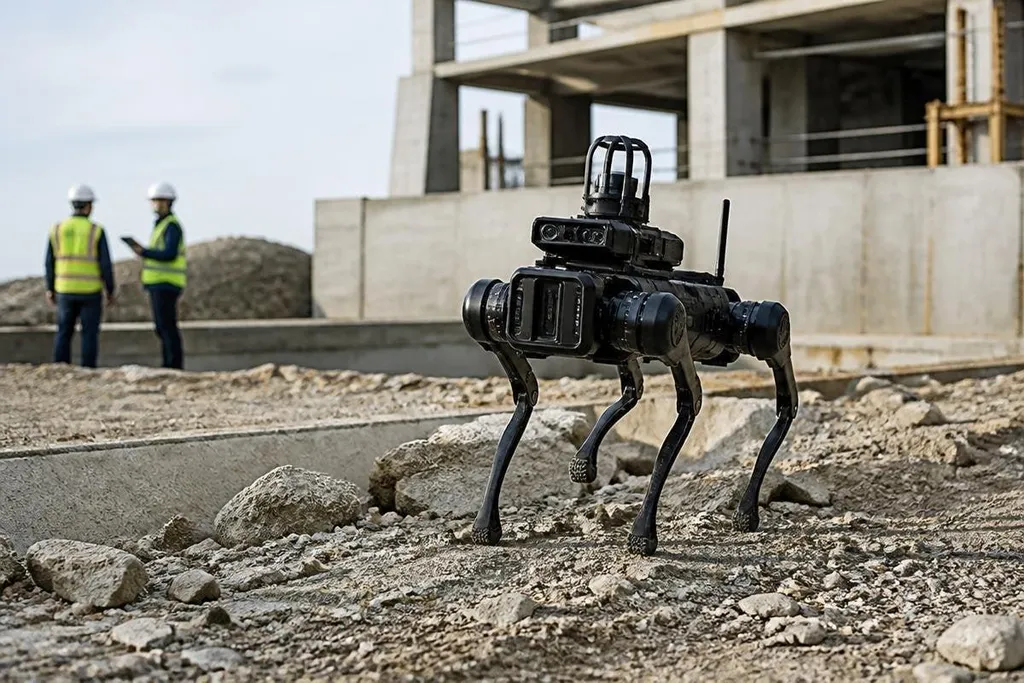
A robot dog can already walk on four legs, climb uneven ground, and carry sensors. The next gains will matter only when the robot can repeat those tasks for hours, recover from mistakes, and earn its place at a work site.
- Better leg control should cut falls and power use.
- Better sensors should help robots work near people and moving equipment.
- Better proof will show which machines can leave the demo floor.
Legs that waste less energy
Walking looks simple until a robot crosses loose gravel, wet concrete, or a stair edge. Each foot must read the ground, place itself, and keep the body stable while the other three legs move.
Watch for control systems that adjust foot height and step timing as the ground changes. A robot that stays upright on one surface may still fail when its feet meet mud, loose stone, or a metal grate.
Power use matters just as much as balance. Motors lift the robot’s body on every step, so better gait control can extend battery time without adding a larger battery. Look for test results that state the walking speed, ground type, payload, and run time in the same report.
Sensors that help the robot read a work site
A robot dog needs more than cameras. A 3D LiDAR sensor measures distance with laser pulses, while cameras help classify objects and read signs. An inertial measurement unit tracks motion when the robot turns or walks over a slope.
The useful advance will be better sensor fusion, where the robot combines these inputs before choosing a step or route. That matters in dark rooms, bright sun, dust, and places where people or vehicles cross its path.
Force sensors in the feet can add another layer of control. They can tell the robot when a foot has touched the ground, slipped, or met an object. The test report should state how the system behaves after that contact, not only show a clean walk through an empty space.
A robot dog can keep its footing and still take the wrong route after a bad command. Reports on Robot24.com can tie autonomy claims to the dog model, software version, test site, date, and recovery result. That record matters before you decide whether the system can handle a changed task without a person taking over.
Autonomy that survives a bad instruction
A robot that follows a fixed route needs less software than one sent to an unfamiliar building. The next useful step is reliable task planning: the operator gives a goal, and the robot chooses a safe route while checking doors, stairs, people, and blocked paths.
That system should also fail in a clear way. If a camera loses its view or a motor stalls, the robot needs to stop, report the fault, and wait for help. A remote operator should see the robot’s position, battery state, sensor warnings, and video feed without guessing what happened.
ROS 2 can connect robot software, sensors, and control tools, but a software framework does not prove that a robot can finish a job. Ask for repeat runs, the number of operator interventions, and results from a site that was not arranged for the demonstration.
Work that can justify the machine
Robot dogs are a poor fit for every task. A wheeled robot usually uses less power on a smooth floor, while a fixed camera can watch one area at a lower cost.
Legs earn their place when stairs, gaps, rough ground, or temporary routes block wheels. Inspection work can also make sense when the robot carries a thermal camera, gas sensor, or other tool into an area that people should enter less often.
The open question is repeatability. One successful inspection says little about a month of work. A useful trial should report how many missions ran, how often a person took control, how many battery swaps were needed, and what the robot failed to inspect.
A buying checklist for the next test
Use these points before treating a robot dog as a work machine:
- Name the route: Include stairs, slopes, floor gaps, and the surface the robot will meet.
- Set the payload: Add the sensor, mount, cable, and any protective case to the stated load.
- Count interventions: Record every time a person stops, guides, or resets the robot.
- Check the data: Ask for speed, run time, battery size, weather limits, and the test date.
- Plan recovery: Decide where the robot stops after a fall, lost connection, blocked route, or low battery.
I'd watch repeatable field tests before buying into another polished walking demo. The robot dog that completes 100 ordinary missions with clear failure reports will matter more than one that crosses a difficult obstacle once.